
Priorities – Highway, Congestion and what we need to do
April 21st 2026 – Big move
After successfully having meetings with Minister Sarkaria, myself and MPP Darouze were able to get the minister to have the province start to go ahead, even though there was a poor decision made by our City Council a year previous.
Thank you very much for the great work. The citizens of Ottawa greatly appreciate moving forward.
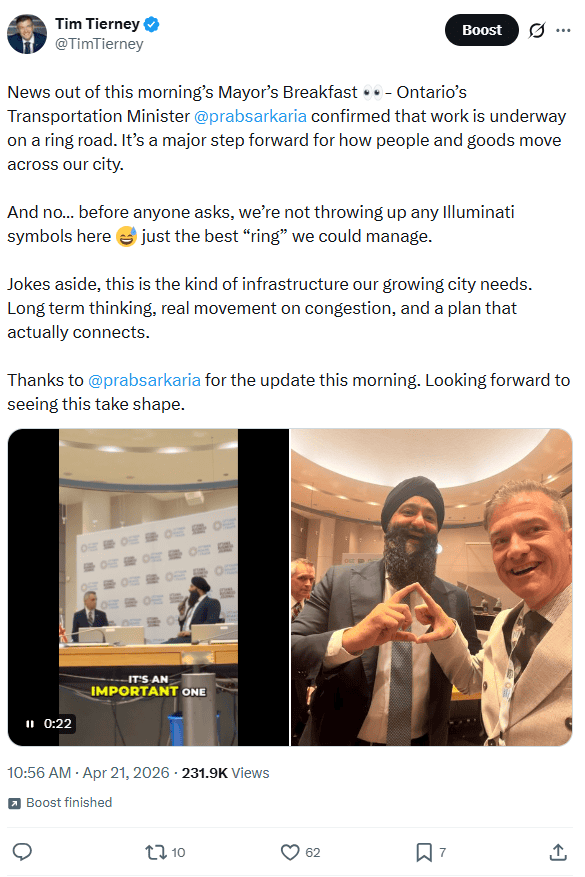
News Stories
‘Everyone is seeing the light’ – Coun. Tim Tierney welcomes increased interest in developing a ring road for Ottawa
April 24-2026
https://compassnews.ca/everyone-is-seeing-the-light-coun-tim-tierney-welcomes-increased-interest-in-developing-a-ring-road-for-ottawa/
August 2025
At the AMO conference, I raised the importance of getting the conversation on a ring road for our city back on the table. It’s an idea I continue to push for, and one that needs to move forward with planning sooner rather than later. Watch the clip below for more.
This page will continue to be added to as the discussion around 417 congestion and city congestion continues to evolve.
While a replacement motion to the one that was debated three weeks prior, that committee was swapped out in the 11th hour, with the replacement motion only removing “Ring Road” the one item that was the most important in my mind and clearly the province, and the citizens of Ottawa…
Please check back on a regular basis.
July 23rd – Council Meeting Update
This past week at Council, we debated a motion connected to the City of Ottawa’s Transportation Master Plan (TMP), which sets the long-term vision for how we plan and invest in infrastructure, roads, and transit. The motion recognized the need to relieve pressure on Highway 417 and called attention to projects of national significance—but in a last-minute change, it removed key language about exploring a future Ring Road. That language had already passed at committee, and in a surprise motion it was stripped at council, which I fought to have the language put back in and lost.
I believe that if we don’t start protecting corridors and setting a bold vision now, we risk losing opportunities that could serve us for decades to come. It’s about more than just fixing what’s broken—it’s about looking ahead and making room for smart, data-driven decisions that will benefit future generations.
As I said during the meeting:
“If we don’t start protecting and looking at the vision… We need vision on this Council. We’ve been doing a great job repairing things. When it came to garbage, people were furious—we changed that number. When it came to the Enbridge pipeline, where they wanted to shut off natural gas, we used a rational decision—we fixed that problem. This has been a Council of fixing up to this point.”
Right now, congestion is affecting residents not just five days a week, but all seven. The 417 remains the only major route through Ottawa. This isn’t about choosing between transit and roads—it’s about building a complete, connected city. That’s why I supported advancing the next origin–destination study, which has now been moved up by a few years. The data we’ll gain from that study is essential to making informed choices—whether it’s a bypass, a corridor, or a future bridge.
I emphasized this point at Council:
“This comes down to two words. The two words that are in the provincial statement: Ring Road. Yes, there are 50 points in that document—but it’s pretty clear. It’s big and bold. It’s right there. Tells us straight up: this is what the province would like us to look at. And as much as you’d like it or not, they actually do have a bit of a stick in the game.”
“We need alternatives in this city. And if we don’t set out vision—and again, if Councillor Johnson’s motion passes—we’ve discounted looking at a vision document in this TMP. It’s a major miss.”
“The whole goal of that—when we missed the boat in the past with some others—was to set out a vision. That’s what a TMP is: a vision document, to look at the future, so we are going to progress that way. And that would achieve what? To make sure we don’t put big buildings in or things where there could possibly be some kind of pathway that the province wants to use for a Ring Road.”
The final vote divided the Council.
Supporting the inclusion of the Ring Road language were:
Matthew Luloff
David Hill
Steve Desroches
David Brown
Allan Hubley
Clarke Kelly
Catherine Kitts
Tim Tierney
Laura Dudas
(was away for the vote but has been a consistent supporter—her ward is shown in dark green)
Opposing the Ring Road were :
Mayor Sutcliffe
Marty Carr
Laine Johnson
Riley Brockington
Jeff Leiper
Rawlson King
Glen Gower
Shawn Menard
Cathy Curry
Theresa Kavanagh
Jessica Bradley
Stéphanie Plante
Wilson Lo (who changed his vote from committee)
Isabelle Skalski (who changed her vote from committee)
Sean Devine (who changed his vote from committee)
Ariel Troster (who changed her vote from committee)

The map above shows how each ward voted—those in green supported keeping the Ring Road language, those in red voted against, and Laura Dudas’s ward is marked in dark green to reflect her intended support:
I’m also actively engaging the Province to continue this conversation so we don’t lose any more time. Whether it’s a bypass, a corridor, or a bridge—these decisions take years to plan and even longer to build. If we wait until the crisis worsens, we’ll be left with fewer options and higher costs.
As I said at the end of the meeting:
“This should’nt be a battle between public transit versus roads. This ia about establishing a vision for our city and if we don’t do it this term maybe we will have to take care of it next term“
📣 Statement by MPP George Darouze:
https://www.facebook.com/share/p/196KpZGcL3/?mibextid=wwXIfr
Update: Minister of Transportation Prabmeet Sarkaria now engaged

I’m encouraged to see growing collaboration on this front, and I’m glad the Mayor is willing to work with us. Stay tuned.
This has never been just about roads. It’s about whether we’re willing to plan ahead—to leave space for the future, even if we’re not ready to build it today. That’s what responsible city-building looks like.
A Must-Watch: The Future of Traffic in Ottawa
The City of Ottawa has a Transportation Master Plan (TMP) that outlines our long-term priorities for transportation, infrastructure & transit.
This motion highlights the need for additional routes around the city, particularly to reduce pressure on the 417 and to address projects of national significance. We remain committed to advancing the priorities already laid out in our TMP.
Before building a costly burden (like Montréal–Mirabel International Airport for example) that doesn’t meet the needs of municipality, let’s be sure to use data driven decision-making, only achievable in the next origin – destination study that has been advanced to the next couple of years.
Will there be a bridge in the future? Yes, but we require this data to make an informed decision.
(We thank you Ray William Johnson for this narrative style)
Latest Statements :
Mona Fortier: Mona Fortier
The Honourable Mona Fortier
Member of Parliament (MP) for Ottawa—Vanier—Gloucester
Liberal Party
Lucille Collard: Statement by MPP Lucille Collard on Proposed Eastern Ottawa Bridge | rhpoa.ca
Member of Provincial Parliament (MPP) for Ottawa—Vanier
Ontario Liberal Party
Third Deputy Chair of the Committee of the Whole House
Member of the Standing Committee on Public Accounts
Rawlson King: June 27, 2025 Newsletter – Councillor Rawlson KingOttawa City Councillor, Ward 13 Rideau-Rockcliffe(Did not support a ring road in the end, removed)
Jacques Legendre
Ex-Councillor, Rideau-Rockcliffe
This past week, I brought forward a motion at the Public Works and Infrastructure Committee to address one of Ottawa’s most urgent issues—traffic congestion on Highway 417. With support from Ontario’s Minister of Transportation Prabmeet Sarkaria, MPP George Darouze, and MP Mona Fortier, we’re pushing for real solutions that reflect how people move today.
As I discussed with Patricia Boal on CFRA’s Ottawa at Work in this recent interview the motion calls for serious planning around alternative routes and a future ring road—not a $3 billion interprovincial bridge that does nothing to fix the gridlock we face daily. I’m proud to share that the motion passed with the support of nine councillors.
But this isn’t the final step. The motion goes to full City Council on Wednesday, July 23.
Traffic congestion in Ottawa is no longer limited to rush hour. Our city’s population has grown rapidly, and the 417 is now clogged all seven days a week. It’s time we face the facts: the highway is over capacity, and the absence of alternative routes when accidents or breakdowns occur brings our city to a standstill.
On Thursday, at the Public Works and Infrastructure Committee, we took a critical step forward. I want to thank the nine members who voted in favour of our city’s priorities and rejected the idea of a $3 billion interprovincial bridge that won’t fix the traffic crisis happening now on our roads. This was not just a procedural motion—it was a statement of intent and responsibility.
Let’s be clear. The 417 is our only major east-west corridor. Whether you’re traveling from Stittsville to Barrhaven, or from Orléans to downtown, you’re relying on a single piece of infrastructure. That’s not sustainable. Every time there’s a crash, a stalled car, or roadwork, the entire region suffers. And it’s not just commuters anymore. It’s families running errands on weekends, seniors heading to appointments, and workers on shifts that don’t follow a 9–5 schedule.
We passed a motion that outlines the need for new thinking. We’ve got to start planning for infrastructure that reflects Ottawa’s real growth—not legacy ideas that don’t fit the way people move today. That means we need to talk seriously about a ring road, alternative routes, and modernized highway planning that isn’t bottlenecked by a single corridor.
I also want to highlight the important contribution of the Ontario Ministry of Transportation. Back in 2022, they produced a report calling for exactly this kind of thinking. The provincial government asked us to consider alternatives to relieve the 417—and that’s what this motion is doing.
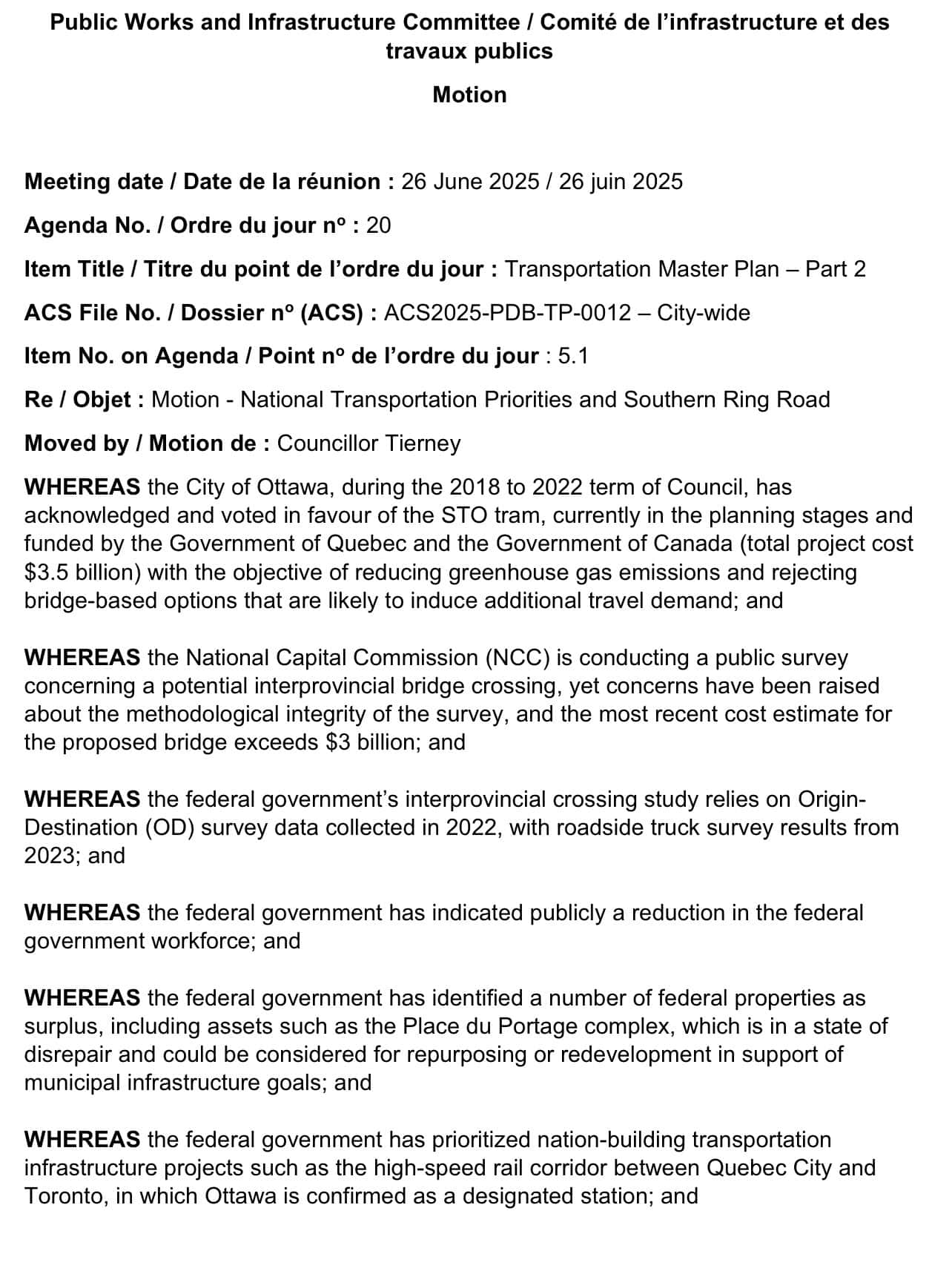
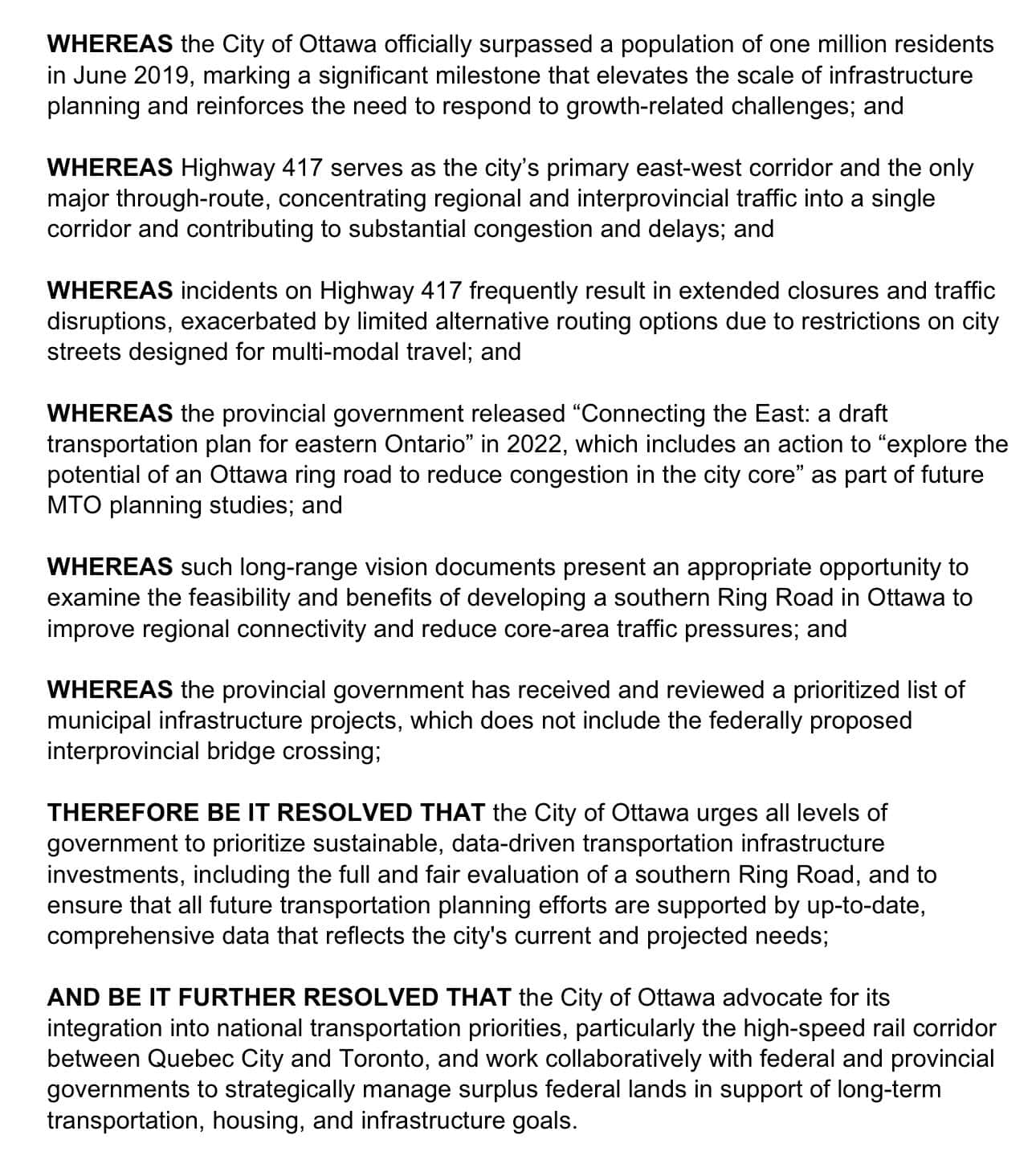
In Favour (9):
Luloff, Ward 1 (Orléans East-Cumberland)
Dudas, Ward 2 (Orléans West-Innes)
Devine, Ward 9 (Knoxdale-Merivale)
Skalski, Ward 20 (Osgoode)
Desroches, Ward 22 (Riverside South-Findlay Creek)
Troster, Ward 14 (Somerset)
Lo, Ward 24 (Barrhaven East)
Kitts, Ward 19 (Orléans South-Navan)
Tierney, Ward 11 (Beacon Hill-Cyrville)
Opposed (2):
Gower, Ward 6 (Stittsville)
Bradley, Ward 10 (Gloucester-Southgate)
To those councillors who supported the motion: thank you. To residents wondering what this means—this isn’t the end. The motion now moves to full City Council on Wednesday, July 9, 2025. We have the support of the Mayor, but your voice matters. If your councillor voted “no” or wasn’t on the committee, now is the time to reach out. This is about building the city you live in and depend on.
I’ve already received hundreds of emails about this—residents saying they support a ring road, they want investment in smarter solutions, and they don’t want to see $3 billion sunk into a bridge that doesn’t address our most immediate problem.
We support infrastructure. We support interprovincial collaboration. But it has to work for Ottawa. It has to solve the real issues. And what we’re seeing today—gridlock, delays, missed appointments, and lost productivity—tells us everything we need to know.
I also want to thank MP Mona Fortier for her leadership. Earlier this week, she made a public statement opposing the bridge proposal, saying clearly that it does not meet Ottawa’s needs. You can read more about that here in the CTV story.
We’re not done yet—but we’ve started something important. Let’s make sure this momentum continues right through to Council on July 9. This is about more than a road—it’s about responsible growth and leadership.
Here is the link to the CBC story covering the motion: Councillor pushes Ottawa ring road instead of 6th bridge | CBC News
Thank you for your continued support and for staying engaged on issues that truly matter to the future of Ottawa.
Statement by MP Mona Fortier on the Eastern Bridge (Kettle Island Bridge)
Ottawa, June 25th 2025
During the last election campaign, I reiterated the importance of adopting a comprehensive regional approach to address interprovincial transit needs within the National Capital Region.
As the re-elected Member of Parliament for Ottawa–Vanier–Gloucester, I believe that, to this day, we have yet to identify a comprehensive solution—particularly on Ottawa’s side—and I am listening to and hearing the many concerns of the Ottawa–Vanier–Gloucester community, including, among others, the neighbourhoods of Vanier, Manor Park, New Edinburgh, Lindenlea, Carson Grove, Beacon Hill, Sandy Hill, and Lowertown.
The Eastern bridge project via Kettle Island—specifically the corridor between Aviation Parkway and Montée Paiement—as proposed by Public Services and Procurement Canada (PSPC), does not meet Ottawa’s needs. It does not guarantee the removal of heavy trucks from the King Edward corridor, which is a crucial issue for safety, air quality, and traffic flow in the downtown core.
Furthermore, PSPC did not consult Ontario’s Ministry of Transportation (MTO) regarding the already overcapacity Highway 417, particularly at the interchange with Highway 174. This new bridge cannot become a “bridge to nowhere”—it must be part of a coherent, integrated, and sustainable regional solution that does not simply shift the problem onto new communities.
With an estimated cost between $3 and $4 billion, this project represents a major investment that does not offer clear or equitable benefits for our region. Furthermore, based on my many conversations with residents and numerous community associations, this project is not a priority.
These voices are instead prioritizing public transit, housing, the fight against homelessness, and sustainable development — priorities that the federal government is supporting through significant investments in affordable housing, the revitalization of the ByWard Market, and public transit in the National Capital Region.
The studies conducted to date by the National Capital Commission (NCC) and PSPC on the Kettle Island option have not demonstrated clear benefits for the City of Ottawa, and risk adding congestion to Highway 417 and worsening traffic for residents east of downtown Ottawa. It is time to shift the discussion toward a comprehensive solution that connects Highway 50 to the 417, addresses the issue of truck traffic in the downtown core, and ensures fair and respectful outcomes for all communities.
I will continue to advocate for this project to be re-evaluated. We must adopt a winning approach for the entire National Capital Region—a modern vision, grounded in up-to-date data, that respects our communities and supports our shared future.
Make your voice heard
The NCC is currently conducting the first phase of public consultations from June 19 to July 10, 2025. As described on the survey website:
“In this first round of public engagement, we invite you to share your thoughts on the project’s early planning and design principles. Your input will also inform the initial project description, which will be submitted to the Impact Assessment Agency of Canada as part of the federal Impact Assessment process.
Results will be shared with the integrated project team, including Public Services and Procurement Canada (PSPC) and the National Capital Commission (NCC).
Your feedback will play a key role in:
• Identifying the project’s most important benefits from a community perspective;
• Understanding potential impacts on people, places, and the environment—and exploring ways to mitigate them; and
• Shaping the initial planning and design principles that will guide the project’s development in future phases.”
To make your voices heard, I invite you to share your opinion and complete this initial survey in this new phase of development:
https://ncc-ccn.gc.ca/projects/eastern-bridge-in-the-national-capital-region
Statement by MPP Lucille Collard – On Proposed Easter Ottawa Bridge
On the Proposed Eastern Ottawa Bridge (also known as Kettle Island and the 6th Crossing) and Regional Transportation Planning:
As the Member of Provincial Parliament for Ottawa–Vanier, I am compelled to speak out against the current direction of the proposed interprovincial bridge at Kettle Island. This project, as it stands, does not serve the interests of Ottawa residents and fails to address the most pressing transportation challenges in our region.
The Ministry of Transportation of Ontario (MTO) has publicly acknowledged that Highway 417 is failing during peak hours, particularly between the 174 and Parkdale. Despite this, and despite recent investments at the 417/174interchange, the Province has disengaged from the regional conversation on interprovincial transportation. This is unacceptable.
Ontario must re-engage and ensure that any new infrastructure aligns with the City of Ottawa’s Official Plan, Transportation Master Plan, and resolves the challenges faced by communities in Ottawa.
The NCC’s recent public survey on the Kettle Island bridge includes language that is deeply troubling. It suggests that the bridge would serve to “connect francophone communities,” implying that Ottawa’s francophones are geographically isolated or concentrated in a single corridor. This is not only inaccurate—it is insulting. The National Capital Commission’s public survey on the Kettle Island bridge includes the following statement:
“Pour que le projet du pont de l’est contribue à renforcer les liens entre les résidents de la région de la capitale nationale,y compris les deux principales communautés francophones…”
Ottawa’s francophone community is vibrant, diverse, and present in every neighbourhood of our city. To suggest that this bridge would advance a “minority objective “is to reduce our rich francophone heritage to a checkbox in a federal infrastructure plan. I call on the NCC and PSPC to immediately revise this language and to engage in meaningful consultation with francophone leaders and communities across Ottawa.
3. A Bridge That Solves Nothing for Ottawa
The urgency to resolve the issue of interprovincial trucks cutting through Ottawa’s downtown streets cannot be overstated. For decades, communities in Lowertown and Sandy Hill have borne the brunt of heavy truck volumes, with serious consequences for safety, air quality, economic development, and livability.
This proposed project—whether called the Kettle Island Bridge, the 6th Crossing, or the Eastern Bridge—cannot go forward without addressing the truck traffic crisis. In its current form, the proposal offers clear gains for Gatineau, while Ottawa residents would see no resolution to the trucking issue, increased congestion on local streets—particularly for Orléans commuters—and further pressure on the already strained 417 corridor.
Call to Action
The time for vague promises and outdated plans is over. We need:
Statement by Ex-City councillor Jacques Legendre – Ward 13 Rideau-Rockcliffe
CONSULTATION RE. KETTLE ISLAND BRIDGE
I wish to submit my views to PSPC, the NCC and interested citizens of Ottawa regarding the proposed bridge connecting Montée Paiement to the Aviation Parkway by a bridge over Kettle Island. I will not be completing the suggested survey since the survey assumes that a bridge would be built. There is little ability to express alternate views through that mechanism.
The proposal currently suggests, as one of the ‘benefits’ of a bridge at Kettle Island, that truck traffic through downtown Ottawa would be reduced. Certainly, that is important but reduction should not be the aim. That truck traffic needs to be drastically curtailed. That downtown route is a nightmare for truck drivers and very bad (even dangerous) for the downtown businesses and residential communities. Given its obvious negative effects, especially on the business and residential sectors, it’s hard to understand the wisdom of shifting a significant fraction of these known problems to a different residential community and immediately adjacent to Montfort Hospital for a mere promised reduction in the negative effects of the existing corridor on Ottawa’s downtown.
What is needed is a new vision for the problems faced on a daily basis caused by the current principal inter-provincial corridor. That vision is a real solution to the current problems and something that the national capital region will eventually need in any case. I speak of a genuine ring road encompassing both the Ontario and the Quebec urban areas not merely a southern by-pass. Of course, this will necessitate not one bridge but two, one to the east of the cores and one to the west.
Ring roads have been built around many cities in both North America and Europe. They are intended primarily to accommodate traffic, whose destination is not the city itself but somewhere beyond, of the necessity of crossing through the city (or regional) core. They also serve commuters from the periphery who find themselves on the wrong side of the cores from their workplace, their homes or their destinations for other purposes. Ring roads also provide benefits for mass transit modes (primarily buses) by reducing the competition for road space they face daily. On the Ontario side, apart from rescuing the downtown, the southern portion of the ring road may reduce congestion on the 417 by providing an alternative east-west corridor.
This project would be worthy of the list of major infrastructure improvements sought by the Canadian government as it seeks to address the economic challenges resulting from the turmoil coming from our neighbours to the south.
I hope that this proposal will provoke a healthy discussion for a better future for Ottawa’s transportation solutions and not merely a rehash of a previously examined and discredited corridor.
Leave a Reply